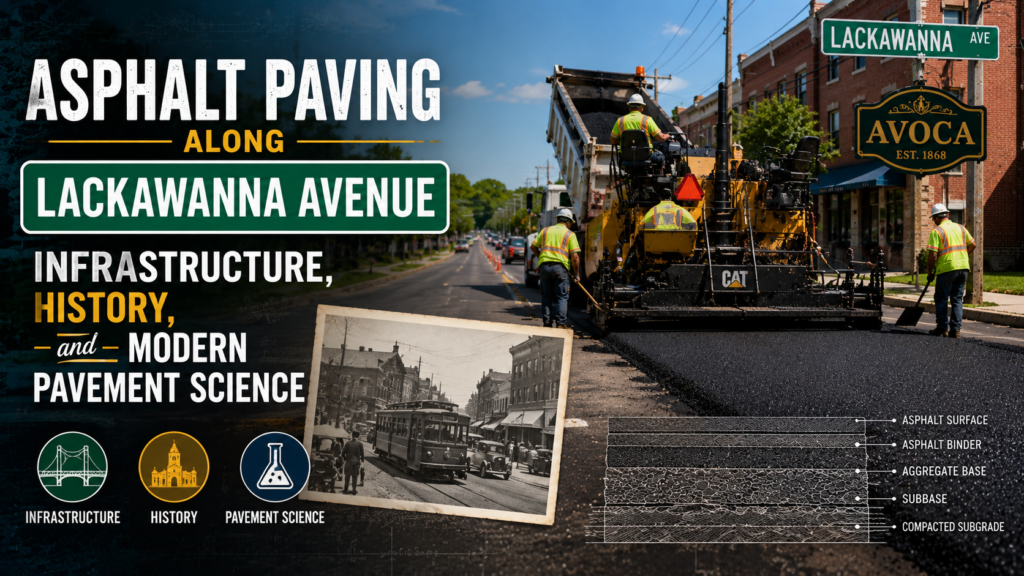
The name Lackawanna resonates throughout northeastern Pennsylvania it belongs to the river, the county seat, and countless streets and avenues that have carried people and commerce through this part of the state for generations. In Avoca and the surrounding Luzerne County communities, Lackawanna Avenue is the kind of thoroughfare that carries the weight of that historical association: a street that has served the community since the borough’s earliest days, connecting neighborhoods to each other and to the wider region.
As a named avenue, Lackawanna Avenue in Avoca reflects the mixed-use character typical of Pennsylvania borough streets residential properties, small commercial establishments, and the kind of steady vehicle traffic that tests pavement endurance year after year. Understanding Asphalt Contractor Lackawanna Avenue paving in this context means understanding both the demands that active streets place on pavement materials and the principles that govern quality installation and maintenance.
The History of Asphalt: From Natural Deposits to Modern Engineering
To fully appreciate modern asphalt paving, a brief historical perspective is useful particularly in a historically conscious community like Avoca.
Natural Asphalt: Asphalt occurs naturally in deposits called asphalt lakes or rock asphalt. The most famous natural deposit, Pitch Lake in Trinidad, has been supplying natural asphalt since the 1800s. Natural asphalt was used to pave some of the earliest improved roads in the United States.
The First Modern Asphalt Roads: The first recorded use of asphalt for urban paving in the United States was in Newark, New Jersey, in 1870. Washington, D.C. saw asphalt paving in 1876, using imported sheet asphalt from European sources. These early pavements established asphalt’s superiority over cobblestone and macadam for providing smooth, quiet surfaces in urban environments.
The Rise of Petroleum-Based Asphalt: As the petroleum refining industry grew in the late 19th and early 20th centuries, a by-product of crude oil refining petroleum bitumen proved to be an excellent substitute for naturally occurring asphalt. This material was far more abundant and consistent than natural asphalt deposits, enabling the mass paving of America’s roads during the automobile age.
The Interstate Highway Era: The Federal-Aid Highway Act of 1956, which funded the Interstate Highway System, created an enormous demand for asphalt that drove major advances in mix design, quality control, and paving equipment. Much of the technology and methodology used in residential and commercial paving today is descended from this era of rapid highway construction.
Modern Mix Design and Performance Grading: The Strategic Highway Research Program (SHRP), conducted in the 1980s and 1990s, produced the Superpave system a comprehensive, performance-based approach to asphalt mix design and binder specification that is now standard throughout the United States. Superpave binders are graded by their performance at both high and low temperatures, providing a scientific basis for selecting appropriate materials for any climate.
Understanding this history helps explain why modern asphalt paving, when done correctly with contemporary materials and methods, is far superior to the paving technology of even a few decades ago.
Asphalt Compaction: The Most Critical and Least Understood Step
Among all the steps in asphalt paving, compaction is arguably the most important for long-term performance and the least visible to property owners observing the work. Compaction densifies the freshly laid asphalt, reducing air voids and creating the interlocking particle structure that gives asphalt its strength.
Why Compaction Matters: Laboratory and field research has consistently shown that a 1% increase in air voids above the target (4%) can reduce pavement life by as much as 10%. A pavement compacted to 8% air voids may last only 60-70% as long as one properly compacted to 4% air voids. This relationship makes compaction one of the highest-value activities in the paving process.
Types of Compaction Equipment:
Steel Drum Rollers: Available in static (weight-only) and vibratory configurations. Static rollers provide kneading action; vibratory rollers add cyclic impact to improve density, particularly in thick lifts. Steel drum rollers are used for breakdown rolling (immediately behind the paver while the mix is hottest).
Pneumatic Tire Rollers: These rollers use air-filled rubber tires at relatively low inflation pressures to provide a kneading, conforming compaction action that improves aggregate-to-aggregate contact and seals the surface. They are typically used for intermediate rolling, after the vibratory steel drum.
Finish Rollers: Typically smaller static steel drum rollers, used to remove roller marks and achieve final surface texture.
The Temperature Window: Compaction must be accomplished within a specific temperature range typically from around 280°F (just behind the paver) down to approximately 175°F (where the mix becomes too stiff to compact effectively). Below this temperature, applying roller pressure may actually crack the surface rather than densifying it.
Experienced paving crews coordinate the speed of the paver with the number and pattern of rollers to ensure the mix is fully compacted before reaching the lower temperature limit. In cooler weather, this requires faster paving speeds or additional rollers; in hotter weather, the window is more forgiving.
Tack Coats and Interlayer Bonding: Invisible but Vital
Between the base course and the surface course of asphalt pavement and between new asphalt and any existing surface being overlaid a thin application of asphalt emulsion called a tack coat is applied. This step is often skipped or inadequately done by less experienced contractors, but it is critical to pavement integrity.
Why Tack Coats Matter: If the surface and base courses are not strongly bonded to each other, they can act as separate layers under traffic loading a condition called debonding or delamination. A debonded surface course essentially floats on the layer below, experiencing much higher stress than a bonded layer would. Delaminated pavement deteriorates rapidly, producing the phenomenon of surface “slippage cracking” distinctive crescent-shaped or transverse cracks caused by vehicle braking and turning forces.
Tack Coat Application: An asphalt emulsion (diluted bitumen suspended in water) is applied by a distributor truck at a carefully metered rate typically 0.05–0.15 gallons per square yard. Too little tack provides insufficient bonding; too much creates a layer of excess binder that can cause surface slippage even after curing.
Residual Rate vs. Application Rate: Emulsified asphalt tacks contain water that evaporates (breaks) after application, leaving behind pure bitumen. The residual rate the amount of bitumen remaining after the water evaporates is the actual bonding quantity. Contractors must understand the difference between application rate and residual rate to achieve proper bonding.
Traffic Restrictions: After tack coat application, the treated surface must not be driven on until the emulsion has broken (the surface changes from brown to black as water evaporates). Driving on uncured tack coat transfers bitumen to vehicle tires, causing tracking and depleting the tack coat.
Pavement Edge Treatment and Its Role in Long-Term Durability
A frequently overlooked aspect of asphalt paving quality is the treatment of pavement edges. Along a street like Lackawanna Avenue where driveways meet curbs, grass verges, and adjacent properties the edge condition of asphalt surfaces significantly influences how long those surfaces last.
The Problem with Unsupported Edges: Asphalt pavement depends on lateral confinement to function properly. Along open edges where the pavement meets grass, soil, or gravel rather than a solid border material the edge lacks the lateral support that interior areas of the pavement have from adjacent material. When vehicles drive on or near an unsupported edge, the material beneath and at the edge compresses and shifts, causing the edge to crack and crumble.
Solutions for Edge Support:
Concrete Curbing: The most permanent edge treatment. A concrete curb provides rigid lateral confinement and also controls drainage and defines the pavement boundary clearly.
Concrete Edging: Narrow concrete headers can be used along driveway edges adjacent to lawns, providing edge support without full curbing.
Asphalt Edge Wedge: A tapered wedge of asphalt material placed along the edge provides some lateral support and creates a gradual transition to the adjacent grade rather than a sharp drop-off.
Compacted Aggregate Shoulder: In some situations, a well-compacted aggregate shoulder alongside the pavement provides adequate support.
The choice of edge treatment depends on site aesthetics, adjacent land use, and the importance of long-term edge durability. Properties on active streets like Lackawanna Avenue, where vehicles regularly maneuver to and from the public road, benefit particularly from robust edge treatment.
How Asphalt Responds to Heavy Rain Events
Northeastern Pennsylvania is subject to periodic intense rainfall events that test both stormwater infrastructure and pavement durability. Understanding how asphalt responds to heavy rain helps property owners make sense of the water-related damage they sometimes observe.
Surface Erosion: If a sealcoat has deteriorated or the surface course has developed micro-porosity, intense rainfall can erode aggregate from the surface a phenomenon that accelerates with each subsequent rain event.
Base Saturation: Heavy rain events that find entry points through surface cracks can rapidly saturate the aggregate base beneath the pavement. A saturated base loses most of its load-bearing capacity. Vehicle traffic on a rain-saturated base causes the classic “pumping” failure, where soft base material is expelled through cracks under tire loads.
Drainage Overload: When stormwater drainage is overwhelmed and water stands on paved surfaces for extended periods, the prolonged contact accelerates binder softening and increases the likelihood of aggregate stripping.
Pothole Acceleration: Existing potholes collect water that continues to soften the edges and base beneath the hole. Rainfall events that fill potholes essentially prevent natural drying of the base beneath.
These dynamics explain why pavement maintenance should be viewed as urgent rather than elective: each season without appropriate maintenance allows incremental damage to compound, and heavy rain events accelerate the process.
Conclusion
Lackawanna Avenue in Avoca is a street that carries both historical weight and daily community activity. The asphalt surfaces along this corridor driveways, parking areas, commercial lots serve the people who live and work here, and their condition reflects the care those people put into their community’s infrastructure.
Modern asphalt paving, when understood and executed correctly, is one of the most durable and cost-effective surface materials available for Pennsylvania’s demanding climate. From the sophistication of Superpave mix design to the critical importance of compaction and interlayer bonding, the science behind quality asphalt work is deeper than most people realize.